Evaluating Open Books Globes and Writing Utensils I for Educational Design
In the realm of digital graphic resources, Open Books Globes and Writing Utensils I represents a specific collection of vector illustrations designed to communicate themes of education, knowledge, and global connectivity. This asset package typically includes an EPS file for scalable vector editing and a JPG file for immediate raster use. The set features iconic imagery such as open books, globes, pencils, and pens, rendered in a clean, black-and-white outline style. For designers, educators, and content creators, understanding the utility, limitations, and appropriate application of this specific icon set is crucial for making informed procurement decisions.
Understanding the Asset Collection
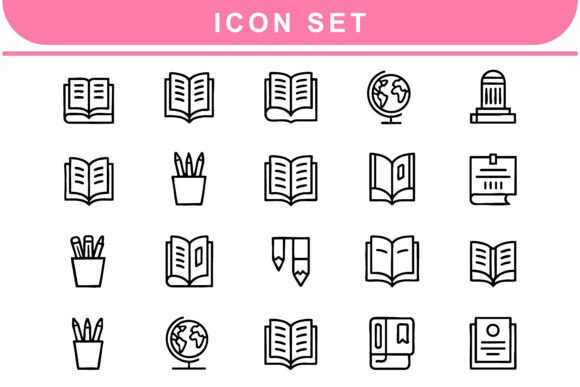
Open Books Globes and Writing Utensils I is fundamentally a visual toolkit intended to symbolize academic and intellectual concepts. The "I" in the title often denotes the first iteration or volume in a series, suggesting a foundational set of symbols. The core components include:
- Open Book: A universal symbol for learning, literature, and information access.
- Globe: Representing geography, world studies, international relations, and global awareness.
- Writing Utensils: Pencils and pens that signify the act of writing, research, note-taking, and creativity.
The design aesthetic is characterized by a flat, modern, and simple approach. By utilizing a monochromatic black-and-white palette with clear outlines, the icons prioritize clarity over decorative detail. This stylistic choice ensures that the graphics remain legible even when scaled down significantly, which is a primary advantage of the included EPS (Encapsulated PostScript) format. The accompanying JPG file offers a quick preview or a ready-to-use version for contexts where vector editing is unnecessary.
Reasons for Interest in This Icon Set
Professionals may seek out Open Books Globes and Writing Utensils I for several practical reasons. First, the thematic consistency is vital for branding educational institutions, libraries, or research organizations. When a project requires a cohesive visual language that instantly communicates "study" or "school," these specific symbols provide a recognized shorthand.
Second, the technical versatility of the file formats appeals to both novice and experienced users. Graphic designers value the EPS file because it allows for infinite scaling without loss of quality and enables customization of stroke weights or colors. Conversely, non-designers or those working on tight deadlines may prefer the JPG file for its ease of integration into documents, presentations, or web pages without requiring specialized software.
Finally, the minimalist nature of the illustrations aligns with contemporary design trends. Modern interfaces and print materials often favor uncluttered visuals that do not compete with text. These icons fit seamlessly into such environments, serving as functional signposts rather than distracting decorations.
Benefits and Tradeoffs
Evaluating the benefits of Open Books Globes and Writing Utensils I requires balancing its strengths against potential limitations. The primary benefit is scalability. Because the core asset is a vector file, the icons can be resized from a small favicon to a large billboard banner while maintaining crisp edges. This makes them highly efficient for multi-platform campaigns where the same graphic must appear in various dimensions.
Another significant advantage is the neutrality of the black-and-white design. Unlike colorful, photorealistic, or heavily stylized icons, these outlines are adaptable. They can be easily recolored to match a brand's specific color palette during the editing process. Furthermore, the simplicity ensures high contrast, which is essential for accessibility and readability in diverse lighting conditions or on low-resolution screens.
However, there are tradeoffs to consider. The most notable limitation is the lack of inherent color. While this offers flexibility, it also means the user bears the responsibility of adding color if a vibrant look is desired. This adds a step to the workflow that might not be necessary with pre-colored assets. Additionally, the "simple" and "flat" style may feel too generic for projects requiring a unique, hand-drawn, or highly detailed artistic flair. If a project demands a specific mood—such as whimsical, vintage, or hyper-realistic—this standard outline style might not suffice without significant modification.
Ideal Situations for Use
Open Books Globes and Writing Utensils I is a strong fit for scenarios where clarity and professional tone are paramount. It excels in:
- Academic Presentations: Slides for university lectures or school reports where the focus must remain on the data and text, supported by clear visual cues.
- Web Navigation and UI: Website headers, footers, or navigation menus for educational portals, online libraries, or e-learning platforms.
- Print Materials: Brochures, flyers, and stationery for schools and research institutes that require high-quality printing at various sizes.
- Icon Sets and Infographics: As part of a larger collection to create flowcharts or diagrams explaining educational processes or global statistics.
In these contexts, the clean lines and recognizable symbols enhance communication without introducing visual noise. The ability to scale the EPS files ensures that the graphics look professional whether they appear on a mobile screen or a printed poster.
When to Consider Alternatives
Despite its utility, Open Books Globes and Writing Utensils I may not be the optimal choice for every project. Alternatives should be considered when:
- Brand Identity Requires Specificity: If an organization has a distinct, complex logo style that relies on gradients, textures, or 3D effects, flat outline icons may clash with the overall aesthetic.
- Target Audience is Young Children: While simple, black-and-white outlines can sometimes appear stark for early childhood education materials. In such cases, colorful, rounded, and character-driven illustrations might engage the audience more effectively.
- Rapid Prototyping Without Editing Tools: If the user lacks access to vector editing software and cannot modify the EPS file, and the JPG resolution does not meet the specific print requirements, alternative stock photos or pre-colored PNGs might be more practical.
- Niche Subject Matter: If the project focuses on a very specific sub-discipline (e.g., quantum physics or marine biology), generic symbols like a globe or book might feel too broad. Specialized icon sets tailored to those fields would offer greater precision.
Practical Decision-Making Insights
When deciding whether to select Open Books Globes and Writing Utensils I, readers should assess their workflow capabilities and project goals. Begin by determining the final output medium. If the project involves high-resolution printing or variable screen sizes, the inclusion of the EPS file is a critical factor that justifies the selection. If the need is strictly for a low-fidelity mockup or a single-use digital document, the JPG file alone may suffice, potentially allowing for a lower-cost alternative.
Consider also the time available for customization. While the black-and-white format is flexible, coloring and adjusting the icons requires proficiency with tools like Adobe Illustrator or similar vector editors. If the timeline does not allow for this post-processing, a pre-styled, colored icon set might be more efficient.
Ultimately, the decision hinges on the balance between versatility and specificity. Open Books Globes and Writing Utensils I offers a robust, neutral foundation for communicating educational concepts. It is best suited for professionals who value scalability, clean aesthetics, and the freedom to adapt basic symbols to their specific brand needs. By weighing these factors against the project's unique constraints, users can determine if this resource aligns with their objectives or if a more specialized alternative is required.